Fix Multi-Warehouse Inventory Chaos
Use Odoo to create clearer warehouse rules for stock movements, replenishment, receiving, picking and cycle counts across every location.
Best fit is an inventory-heavy team with multiple locations, manual workarounds, transfer confusion, fulfilment delays or reporting gaps that need a more reliable operating structure before growth adds more pressure.
Buyer judgement
Multi-warehouse design has to protect the customer promise
Multi-warehouse work is not just adding more locations to a system. The real question is whether the business can make clear promises when stock is split across stores, warehouses, 3PL partners, supplier dropship paths and ecommerce channels.
The operational risk usually appears in the gaps: stock reserved in the wrong place, transfers that are not trusted, purchasing that ignores location demand, or customer service teams unable to explain where an order is stuck. Odoo can support the structure, but only if rules are written in business language first.
A useful design starts with how stock should flow, who owns each exception and which numbers leadership needs to trust. Then configuration, barcode flows, replenishment, shipping and reporting can follow the operating model instead of forcing teams into workarounds.
- Define when stock is available to sell, reserved, in transfer, damaged, awaiting receipt or committed to a channel.
- Test inter-warehouse transfers, backorders, partial picks, 3PL handoffs and location-specific reorder rules before go-live.
- Make reporting location-aware so leaders can see stock risk by warehouse, channel and fulfilment promise.
For connected decisions, review inventory management, shipping and 3PL integrations and reporting dashboards.
Common Problems
Typical operational problems found across multi-warehouse workflows, especially where teams rely on manual workarounds, disconnected systems or unclear warehouse rules.
Receiving Errors
Transfer not recorded properly
No cycle count structure
Inaccurate stock valuation
Warehouse confusion
What We Implement in Odoo
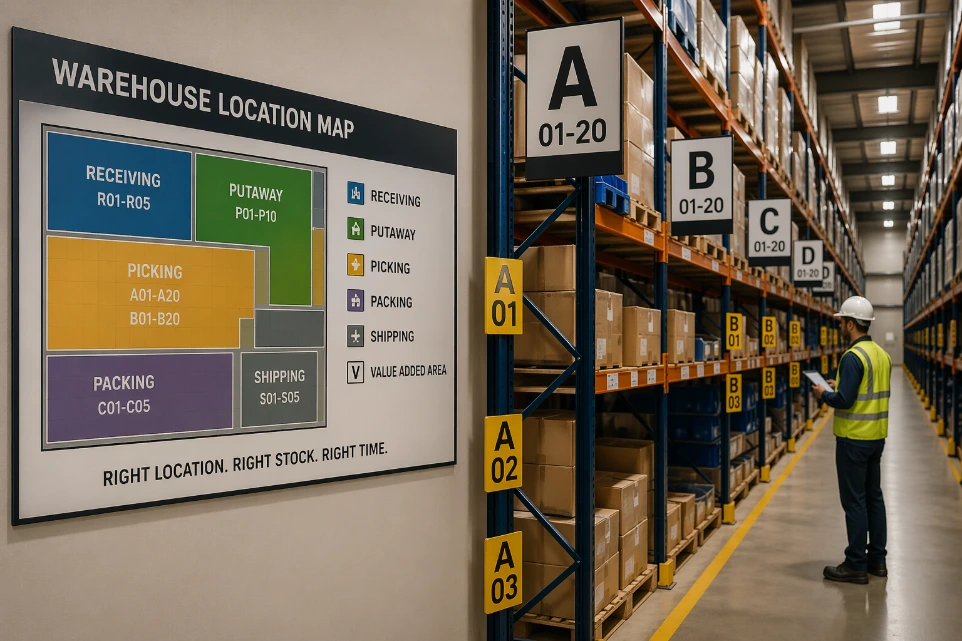
Location architecture
Structured locations for stock control.
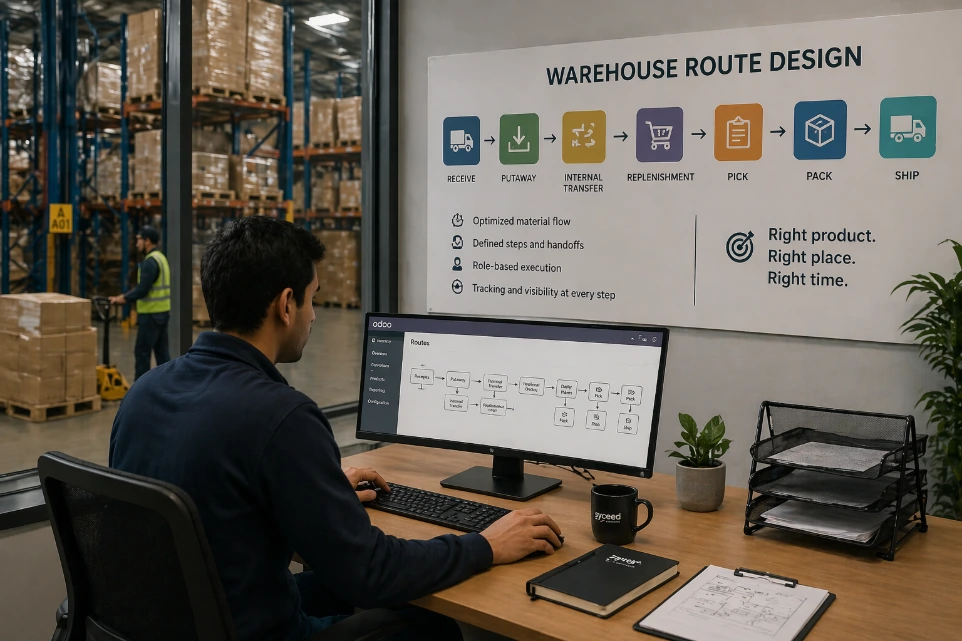
Route design
Defined stock paths across workflows.
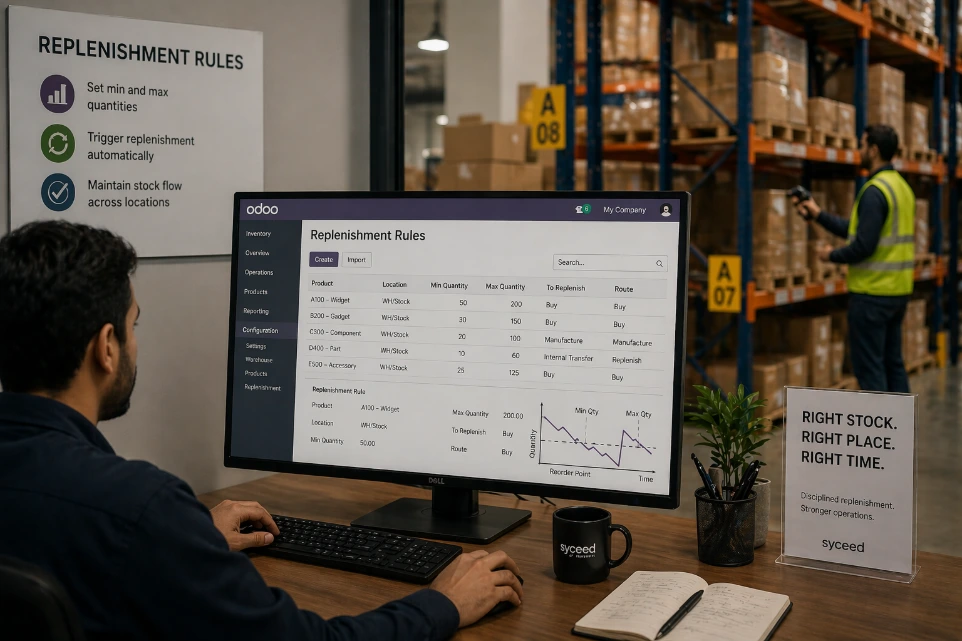
Replenishment rules
Configured replenishment for stock flow.
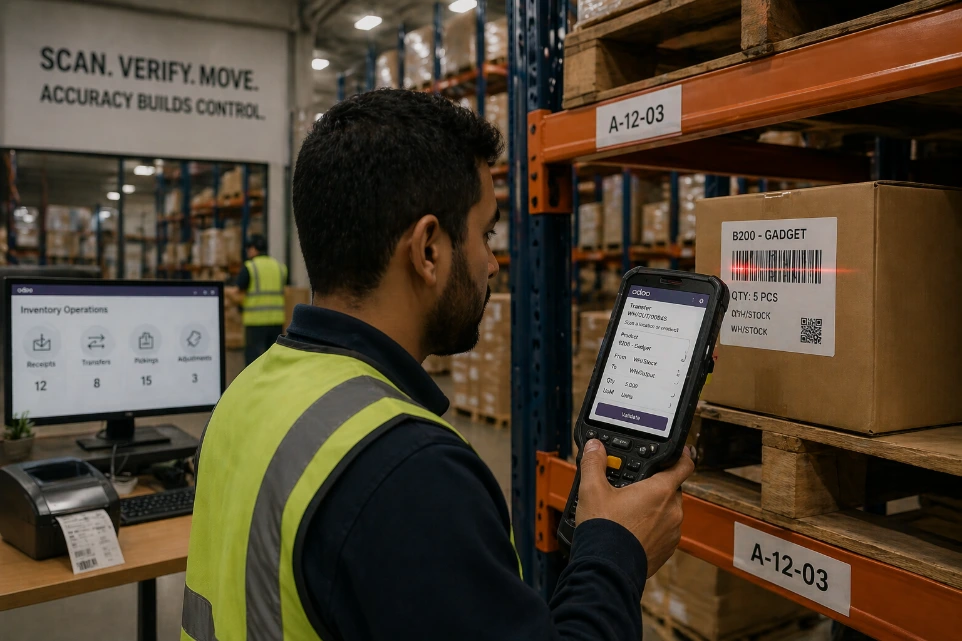
Barcode scanning
Scan-based execution across warehouse tasks.
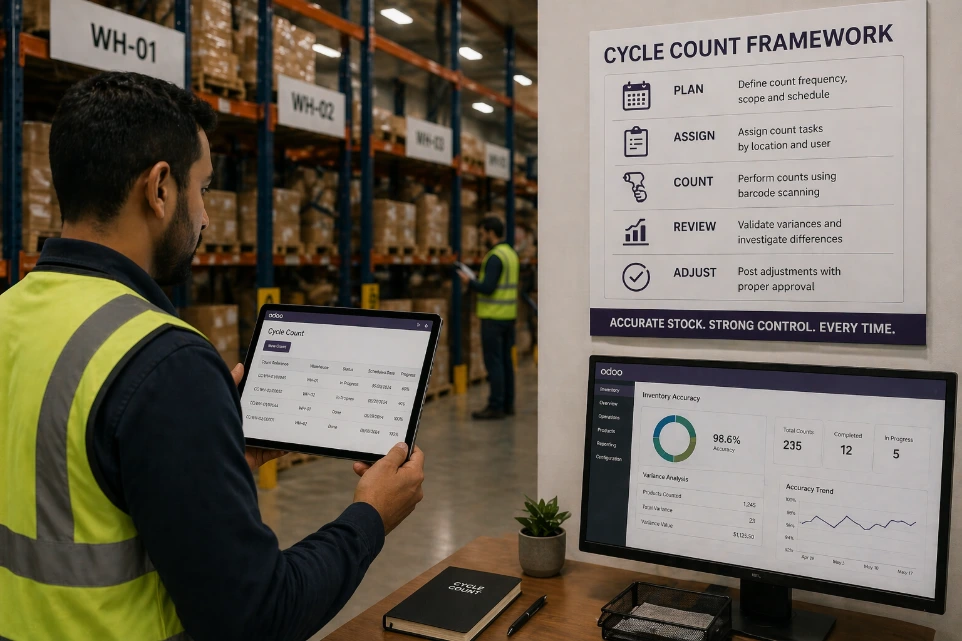
Cycle count frameworks
Count routines for ongoing inventory accuracy.

Expected Operating Outcome
Disciplined, auditable inventory system
Built on standardised processes, traceable stock movements, and more consistent inventory control across the warehouse network.
New to Odoo? Read what Odoo is, how pricing works and why official partner support matters.
Odoo warehouse management for multi-warehouse operators
Use Odoo to improve visibility and control across multiple warehouses. Syceed helps map transfers, replenishment, barcode discipline, cycle counts, fulfilment rules and responsibility across locations so stock decisions become clearer.
Implementation Questions to Resolve Before You Start
These questions are worth answering before warehouse configuration starts. They affect data quality, user adoption and whether Odoo improves stock control in daily operations.
What should be mapped before configuring multiple warehouses in Odoo?
Start with the physical warehouse structure, stock ownership, receiving points, dispatch areas, transfer paths, returns handling and any 3PL or dropship locations. The configuration should reflect how stock actually moves, not just how locations appear on an org chart.
Why do multi-warehouse Odoo projects often fail?
The common failure point is weak process design before configuration: unclear routes, poor stock data, unmanaged exceptions, inconsistent receiving and no agreed cycle count routine. Odoo can enforce discipline, but only after the operating rules are clear.
Can Odoo support barcode workflows across receiving, picking and transfers?
Yes. Barcode workflows can support receiving, putaway, picking, packing, internal transfers and cycle counts. The value depends on designing scan steps that match the warehouse team’s real workflow.
How should stock accuracy be protected during migration?
Stock accuracy depends on data cleanup, location mapping, opening balance controls, test transfers, user rehearsal and a cutover plan that avoids mixing old and new stock movements.
Can this connect with Shopify, shipping and finance systems?
Yes. Multi-warehouse projects often need eCommerce, shipping and finance integrations so orders, fulfilment, stock value and reporting stay aligned across systems.
What should be reviewed after go-live?
Review exception reports, transfer behaviour, order delays, user workarounds, cycle count variance and replenishment rules. The first weeks of live use usually reveal where the process needs tightening.
Useful Next Steps
Odoo implementation - plan the full implementation path
Odoo migration - manage data and cutover risk
Odoo integrations - connect shipping, finance and eCommerce workflows
Odoo readiness scorecard - assess fit before committing
Multi-warehouse Odoo
Multi-warehouse Odoo only works when stock movement rules are explicit
Syceed helps Australian inventory-led businesses use Odoo to control stock across warehouses, locations, ecommerce channels, purchasing, fulfilment, transfers, replenishment and reporting.
Warehouse decisions to make before configuration hardens
- Warehouse, location, bin, route, picking, packing, receiving and transfer structure.
- SKU, barcode, unit of measure, lot, serial, damaged stock and adjustment rules.
- Purchasing, replenishment, minimum stock, supplier lead time and inter-warehouse transfer logic.
- Shopify, marketplace, 3PL and shipping availability rules so customers do not buy stock the business cannot fulfil.
- Inventory reporting, cycle count, stock valuation and finance reconciliation expectations.
Warehouse scope should connect to inventory management, Odoo implementation, readiness assessment, implementation process, budget planning and support after go-live.
For connected workflows, review Shopify integration, shipping and 3PL integrations, reporting dashboards, migration planning, project rescue and proof from LatestBuy.
Common multi-warehouse Odoo questions
What does multi-warehouse Odoo need to control?
It needs clear warehouse locations, routes, replenishment rules, transfers, picking, packing, stock adjustments, ecommerce availability and reporting so stock is trusted across the business.
Why do multi-warehouse Odoo projects become risky?
Risk usually comes from unclear location structure, inconsistent SKUs, manual stock corrections, weak transfer rules, untested replenishment logic, poor barcode discipline or integrations that sync the wrong availability.
Can Odoo support Shopify and multiple warehouses?
Yes, but ownership rules need to be clear. Odoo should usually control stock, purchasing, warehouse movement and fulfilment logic, while Shopify remains the customer-facing storefront.
What should be tested before go-live?
Testing should cover receiving, transfers, replenishment, picking, packing, backorders, returns, damaged stock, cycle counts, Shopify availability, 3PL handoffs and reporting reconciliation.